One stumbles upon this term sometimes, but what does it actually mean for an planetary body to be "in an RG [runaway greenhouse] state"?
Considering that the influx of energy is (more or less) stable, any process that lowers the outflux of energy will only raise temperature up to a point, when a new equilibrium is reached (as increased temperature leads to increased outflux). To get an true runaway climate, one would need to lower the outflux to zero, something that is only possible at absolute zero – a state that will be quickly left behind in the case of influx of energy.
I can only assume that by saying "runaway" scientists actually mean "reaching a higher equilibrium temperature". So to me the term "runaway greenhouse" is nonsensical, sensationalistic, misleading and anti-scientific, and this reflects badly on any scientists using such terms uncritically.
Wednesday, September 11, 2013
On "Runaway Greenhouse" Climate
From a comment I left on another blog:


Monday, September 9, 2013
George W. Obama
Dear Mr President – STOP
Dear Mr. PresidentI can no longer see an difference from Mr. Obama to Mr. Bush
the world has gone astray
Brothers are dying
they won't live to see today
Was it all worth it
you had to lie to get your way
Bloods thicker than water
what a price we had to pay
Wednesday, September 4, 2013
An Ancient Meteorite Impact Crater in Saint-Laurent-la-Vernède?
Now I might be seeing things that are not actually there (an old human trait, I take it), but to my (untrained) eye it looks like there might have been (during our geologic past) an meteoroid impact at an oblique angle in the area where today lies Saint-Laurent-la-Vernède (44°06′21″N 4°27′31″E, in the south of France, department Gard):

Now I am no expert in these matters, and there might have been other geologic forces creating this, like for example glaciers and long gone streams shaping some geologic fault. But damn, wouldn't that be cool, if this were the result of an meteorite impact?

Surely there should be geologic reports about that region? Alas, my search engine skills are not good enough to find something… When, a couple of years ago, I stumbled in Google Earth upon the old river valley of the Donau ("Urdonau") in the "Wellheimer Trockental" between Rennertshofen and Dollnstein, I was at least able to find sites about this. But here? I found nothing in the internet about this geologic formation.
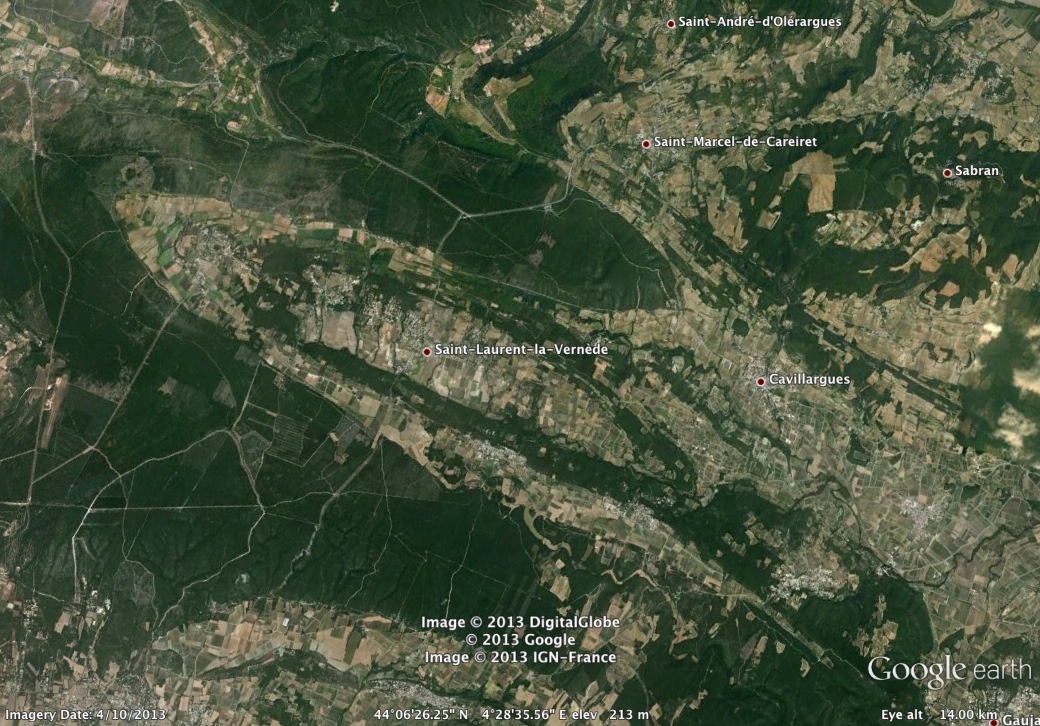
The French township of Saint-Laurent-la-Vernède lies in an depression, the elongated green ring of forests constitutes an ridge, and the fields around that again form an depression. The ring has an very coarsely approximated length of something over 7 km (heading 280 degrees) and a width of 1.5 km. The western end of the ridge is more rounded than the eastern end, and there in the west is a hill of sorts around the town of La Bruguière. The larger green forest are part of some local hills, framing the entire area (except to the east-south-east). Forests and fields do not exactly follow hills and depressions, but give a good indication of the topology in that area.
Now I am no expert in these matters, and there might have been other geologic forces creating this, like for example glaciers and long gone streams shaping some geologic fault. But damn, wouldn't that be cool, if this were the result of an meteorite impact?

In the south-east, the D166 road (44°05'50.33" N, 4°30'52.30" E) were the small river "La Tave" pierces through the ridge to drain to the east towards the Rhone. Some strata are visible in Google's Streetview. What could a geologist find around here?
Surely there should be geologic reports about that region? Alas, my search engine skills are not good enough to find something… When, a couple of years ago, I stumbled in Google Earth upon the old river valley of the Donau ("Urdonau") in the "Wellheimer Trockental" between Rennertshofen and Dollnstein, I was at least able to find sites about this. But here? I found nothing in the internet about this geologic formation.
Sunday, September 1, 2013
Cheap Astronomy – Ancient Wisdom
A man can't stand, he can't fight. A man can't breathe, he can't fight. A man can't see, he can't fight.In the matter of hand-to-hand combat (in which I have no experience, thankfully) one needs three things according to ancient wisdom:
-- The Karate Kid, Part III
- Being able to stand
- Being able to breathe
- Being able to see
But it reminded me of basically three areas you need to do visual astronomy (to paint a very simplified picture):
- Optics, seeing and eyes, to be able to see
- Some sort of mount, for stability
- And "usability"
Another point not on the radar for beginners: To be able to see is more than just the quality of "optical tube assembly" (and more than the combination of OTA with eyepieces). Unfortunately this is a topic of its own.
The second point is usually overlooked as well by inexperience beginners (and exploited by the industry sell them undersized mounts): One is using high magnifications and any shaking caused by a mount will make it hard (if not impossible) to use an astronomical telescope. There is the measure of maximum telescope weight supported by an mount, but (beyond the question of how this is measured) this is not a simple number or measurement: A long telescope will put more strain on a mount than a short telescope with the same weight. Person A is more tolerant to shaking than person B. And so on. But it stands: The more stable a mount, the more enjoyable a view through a scope.
And while the third point seems simple (to the point of being a tautology), it is the hardest to grasp: If an telescope setup lacks usability, it is not usable. If you can't find things in the night sky with it, what good is a telescope? What good is a telescope and mount, if it is so heavy that you rather leave it at home than drag it with you? What good are high magnifications if the focuser shifting is so bad that you can't actually reach focus?
Now if it were just "Good, But Expensive Astronomy" I'm after, I would recommend the best setup that money can buy (and there are some out there). Some of these question can be solved by throwing money at them. But only up to a point.
If you want to do astronomy, you have to invest time, acquire knowledge and skills – just like any other hobby, just like a craft or a sport. Sure you can have fun just "dabbling" in astronomy, but for me the fun in is improving, advancing, progressing.
And for me it is "Cheap Astronomy" I'm after, or rather affordable astronomy, with a good ratio of cost to optical quality, stability and usability. With some some measured modifications. Investing time to save money and gain knowledge.
More to follow.
Monday, August 26, 2013
Cheap Astronomy – Things That Are Free: Meteoblue's "Astronomical Seeing" Prediction
When I prepared myself for the Triple Conjuction, I had to drive to another site – so I wanted to know beforehand how the weather would be, and especially if there were clouds or not.
One thing I found mildly helpful was looking into nearby airports. I have two small airstrips near by, and both have some interesting weather information. One is military and has some cloud predictions, the other is a small private one with temperature and dew point record for the last 24h, plus current webcam images
Since then I tried to find a website which is more dedicated to weather in the context of astronomical seeing. Of course one immediately finds the "Clear Sky Chart" website and Weather Underground's Astronomy service – but unfortunately they cater mainly to the continental US and Canada.
I then searched some more and found the "Astronomical Seeing" service by Meteoblue. Until now I have mainly used their cloud prediction and found it to be quite reliable.They have many more features (like "seeing"), and I hope to utilize them in the future – but I am neither proficient enough nor have I used it other informtion to comment on the quality of their "seeing" information.
Sow what else do they offer? They offer quite some information, with hourly resolution for three days. Most of it presented in color, so one can immediately grasp what one has to expect for the next days.

The information about astronomical weather they display is:
*All eight planets except the Earth – duh – plus the dwarf planet Pluto.
One thing I found mildly helpful was looking into nearby airports. I have two small airstrips near by, and both have some interesting weather information. One is military and has some cloud predictions, the other is a small private one with temperature and dew point record for the last 24h, plus current webcam images
Since then I tried to find a website which is more dedicated to weather in the context of astronomical seeing. Of course one immediately finds the "Clear Sky Chart" website and Weather Underground's Astronomy service – but unfortunately they cater mainly to the continental US and Canada.
I then searched some more and found the "Astronomical Seeing" service by Meteoblue. Until now I have mainly used their cloud prediction and found it to be quite reliable.They have many more features (like "seeing"), and I hope to utilize them in the future – but I am neither proficient enough nor have I used it other informtion to comment on the quality of their "seeing" information.
Sow what else do they offer? They offer quite some information, with hourly resolution for three days. Most of it presented in color, so one can immediately grasp what one has to expect for the next days.

The Meteoblue information for the current day for a semi-randomly selected city in Russia – things like daytime/nighttime and cloudcover are immediately obvious. Notice the "mouse-over" with planet information in the lower right corner.
The information about astronomical weather they display is:
- Cloudcover (low, mid and high)
- Different seeing indices (different calculation methods)
- Jet stream and "bad" layers
- Temperature and humidity
- Daily Sun rise and Sun set
- Daily Moon rise, Moon set and Moon phase (both as number and as text)
- Hourly information for visible planets* (with coordinates via "mouse over")
*All eight planets except the Earth – duh – plus the dwarf planet Pluto.
Saturday, August 24, 2013
Cheap Astronomy – Put Some Flock On Your Barlows!
I would have wanted to look at the Moon tonight, but the clouds are prohibitive today. So I played a bit around with an artificial target I have and to my horror found out that my Barlows were not useful for looking at bright targets. By now I have six Barlows and – with the sole exception of the "KSON 3x achromatic" – each and everyone had problems with internal reflections. Thankfully in each case the usefulness of the Barlow was hugely improved by putting flocking material on the cause of the internal reflection.
These are the Barlows I have now:
What to do?
To check a Barlow, put the Barlow in the focuser (best to test in the fastest scope you have and do not put a eyepiece in), and then shine a flash-light in the scope: When looking into the Barlow, do you see any reflections? Flock 'em! Smoke 'em out! Only a flat black surface is a good surface.
Similarly you can go and remove the Barlow, shine a flash-light into the scope's front end and then look into the focuser: Do you see any reflections were they shouldn't be? Flock 'em!
And for ultimate satisfaction, put eyepiece(s) in the focuser, shine the flash-light from the front and then look from the front: Do you see any reflections? Remove 'em! All my eyepieces (and all my star diagonals) had chrome barrels were the front edge and the inside of the barrel reflected light like crazy. And even if the inside of the barrel was painted in flat black, it was not nearly enough. Especially in the case of the 2" star diagonal I had a huge improvement by flocking the barrel.
So, if it shines in the flashlight, it is bad for contrast. It is most obvious on objects like the Moon or the planets. In other cases (e.g. when there are bright stars a little bit out of the FOV for a dark nebula) the result may be a little less obvious (though probably worth a try as well). As one of the next objects I want to see is Jupiter, I will be needing my Barlows, and I will want every bit of contrast I can squeeze out of my scopes. So the cloudy skies tonight were a blessing.
And one last thing I found: My SR6mm eyepiece has a lot of shiny black plastic surfaces at an right angle to the optical axis – putting some flocking material on it improved contrast especial in when used in combination with a Barlow.
BTW: In many cases I do not stick the flocking material on. I simply leave the protective foil on, roll up the flocking material and put it on the inside of e.g. a barrel. One just needs to cut it to the exact inner diameter of the tube (first make it a bit to long, then cut off small slices until it is "just right"), then one can lay it there "flush" and it will have a little bit of tension that holds the material there.
On other surfaces I try to put it in there so the flocking material holds there "mechanically".
Only in stuborn cases (were the material will not hold "by itself") do I need to remove the protective foil and stick it on the surface (point in case: the inside of the plastic retaining ring).
These are the Barlows I have now:
- 3x "long barrel" cheap plastic Barlow (0.965 inch)
- 2x all metal "Japan" Barlow (0.965 inch)
- 2x "shorty" cheap plastic Barlow with singlet glass lens (1.25 inch)
- 2x Knight-Owl Barlow (1.25 inch)
- 3x Knight-Owl Barlow (1.25 inch)
- 3x KSON achromatic Barlow (1.25 inch)
What to do?
To check a Barlow, put the Barlow in the focuser (best to test in the fastest scope you have and do not put a eyepiece in), and then shine a flash-light in the scope: When looking into the Barlow, do you see any reflections? Flock 'em! Smoke 'em out! Only a flat black surface is a good surface.
Similarly you can go and remove the Barlow, shine a flash-light into the scope's front end and then look into the focuser: Do you see any reflections were they shouldn't be? Flock 'em!
And for ultimate satisfaction, put eyepiece(s) in the focuser, shine the flash-light from the front and then look from the front: Do you see any reflections? Remove 'em! All my eyepieces (and all my star diagonals) had chrome barrels were the front edge and the inside of the barrel reflected light like crazy. And even if the inside of the barrel was painted in flat black, it was not nearly enough. Especially in the case of the 2" star diagonal I had a huge improvement by flocking the barrel.
So, if it shines in the flashlight, it is bad for contrast. It is most obvious on objects like the Moon or the planets. In other cases (e.g. when there are bright stars a little bit out of the FOV for a dark nebula) the result may be a little less obvious (though probably worth a try as well). As one of the next objects I want to see is Jupiter, I will be needing my Barlows, and I will want every bit of contrast I can squeeze out of my scopes. So the cloudy skies tonight were a blessing.
And one last thing I found: My SR6mm eyepiece has a lot of shiny black plastic surfaces at an right angle to the optical axis – putting some flocking material on it improved contrast especial in when used in combination with a Barlow.
BTW: In many cases I do not stick the flocking material on. I simply leave the protective foil on, roll up the flocking material and put it on the inside of e.g. a barrel. One just needs to cut it to the exact inner diameter of the tube (first make it a bit to long, then cut off small slices until it is "just right"), then one can lay it there "flush" and it will have a little bit of tension that holds the material there.
On other surfaces I try to put it in there so the flocking material holds there "mechanically".
Only in stuborn cases (were the material will not hold "by itself") do I need to remove the protective foil and stick it on the surface (point in case: the inside of the plastic retaining ring).
Thursday, August 15, 2013
The Effective Spy?
Adam Curtin: BUGGER
… The spy world became a fascinating other universe that was full of layer upon layer of deception, where the men who inhabited it spent their time trying to penetrate through the circles of falsehood to the inner sanctum of truth.
It was an image that was powerfully helped by John Le Carre's novels - and his anti-hero George Smiley. Le Carre's novels were a clever piece of PR - because they appeared to be more gritty and realistic than the glamourised James Bond image.
But it was just another layer of deception - because Smiley and his search for a hidden mole expressed powerfully the paranoid and unfounded fantasies of the dissident MI5 agents.
But it was a world that was all made-up. Le Carre - who had himself been a spy - admitted this, and described what the true reality of the spy world was:
For a while you wondered whether the fools were pretending to be fools as some kind of deception, or whether there was a real efficient service somewhere else.
Later in my fiction, I invented one.
But alas the reality was the mediocrity. Ex-colonial policemen mingling with failed academics, failed lawyers, failed missionaries and failed debutantes gave our canteen the amorphous quality of an Old School outing on the Orient express. Everyone seemed to smell of failure.
Subscribe to:
Posts (Atom)